
On an alien, unexplored planet with unfamiliar skies signs of life may be difficult to find. Scanning from orbit does not reveal everything, the ISS told us that, when the first astronauts looked down and borders disappeared, ships were lost against the waves, rivers became winding serpents across the landscape, cities became smudges of different colour.
Until night falls, when the hand of mankind lights up the darkness with glittering jewels of light.
Of course, on Earth there is so much radio noise that a visual inspection is an afterthought. But are we typical?
Many catastrophists believe we should turn off the lights, stop the radio signals, become invisible. They think aliens may be hostile and we should not be waving the flag. Some merit to this view.
The contrary position is that any aliens advanced enough to visit will find us primitive and not worth the investment.
But you never know.
We take a graded approach when we look for life on other planets. First we scan for electromagnetic radiation, then we look for lights at night, then we try to spot large scale structures on the surface that are obviously not natural. In high orbit this is not easy, we may not see all the planet, could easily miss something. This logic assumes that any civilisation mirrors our own path to technology.
Two thousand years, nothing in the cosmic time scale, we were riding horses and fighting with swords and spears. We were scattered across the globe filling niche after niche, and surviving, living within the constraints of nature. An alien visit would form an oral tale meaningful only to those who saw them.
After the preliminary scans, we take an aerial look, one landmass at a time, starting at the equator, because, after all, that is where we started.
Our craft, half jet, half flying saucer, is small and fast and (we hope) mostly invisible to any ground based inhabitants who may look up.
Today is our second day of surveying.
We are flying across the largest landmass, and have moved to about 20 degrees north latitude. How do we know it’s north? Based on the direction of the planet’s orbit around its sun and planetary rotation. Sun rises in the east, so north is to the left. Easy.
Longitude is arbitrary, we pick a point on the equator that is distinctive and call it zero degrees.
Distance is different for the same degree of latitude vs Earth, obviously, though we are using the same coordinate system. So we can all follow it.
For the most part the job is boring, this is my twelfth planet, and there’s some commonality between rocky planets with water. Greenish vegetation, tress or thick shrubs mostly, the odd desert, the odd mountain range of varying heights Our craft scans everything, but does not see the way eyes see.
The craft will follow a programmed route, scan everything ahead and to the sides. But a glint of light in the far distance will not attract its attention the same way a human brain does. With generations of natural selection, a glint could be anything. A piece of quartz, a mirror, the lens of a targeting rangefinder. Humans react differently according to context, and fear.
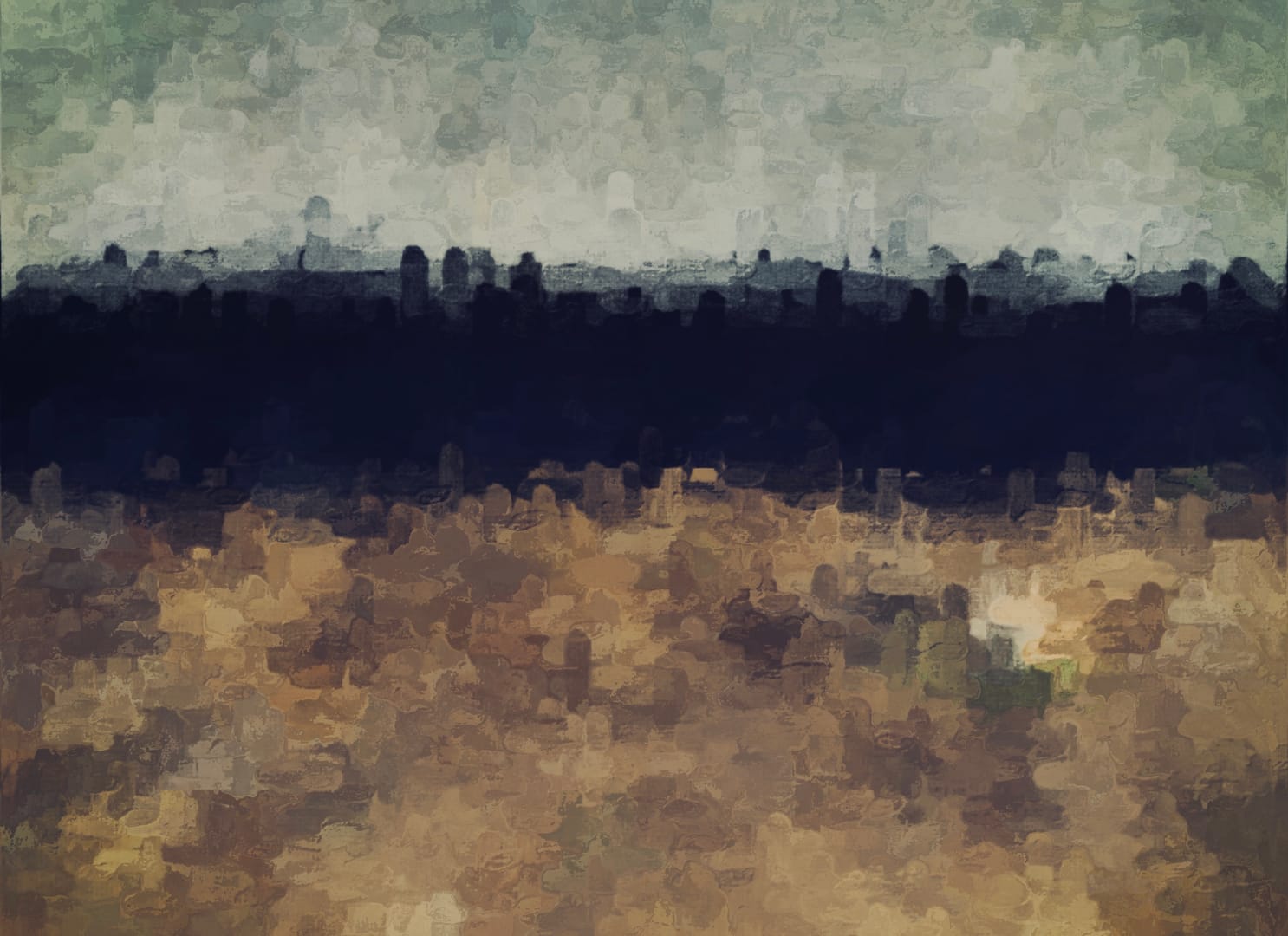
Today the morning was semi-clear, the sky a green grey, the sun muted. Mostly the vegetation was a scrubby ochre, mottled. Not a fine grained sandy desert, more akin to a bleached central Australia or where the Kalahari meets the plains of southern Africa.
No signs of sentient life, no doubt small crawling things of various sizes. No herds of animals raising dust, no rivers or lakes. Just arid nothingness.
We came to the end of the dry landscape. My pilot and I pinched ourselves awake. The ship’s Captain asked us to pay attention to the change in landscape ahead, the end of our desert.
At first, a dark line on the horizon, growing large as we approached.
What is that in the distance?
It’s dark, but something is ahead, surely not natural.
Those shapes, rising out of the blackness, they are surely geometrical.
Are they the top of buildings?
Is that industrial smog?
Is this the life we are looking for?”
#digital
#black
#horizon
#landscape
#space #mini-sci-fi
Published on #Medium May 2026