
When he was eleven, Simon started writing and drawing in a notebook. Not regularly. Just every now and then when the wind blew strongly enough to get his attention.
So many questions, so few answers. Is warm wind different to cold wind? Wet different to dry? Mountain different to desert? Sea different to land? Night different to day? Rising different to falling?
As he grew Simon never forgot. He took up sailing and kept looking for the wind. He could see its effects, the rustling of the water surface on a calm day, the joyful whitecaps when it was windy, the heeling of boats around him, the pressure in his sails driving him forward.
The haze of a humid salt-carrying sea breeze was the closest he got, but it wasn’t enough. No better than a night mist swirling gently past a street lamp. Monochromatic and one dimensional.
Birds, he found out, could see magnetic lines. Also invisible. That’s how pigeons found their way home, migratory birds travelled half a world to avoid winter, and seabirds returned to remote islands. Is that a clue? A genetic modification to the eye, making the invisible visible?
If birds can follow the map laid by a magnetic field, perhaps they can see the wind too, that’s why they fly so well.
Simon’s obsession may have faded as he matured, as other interests distracted, and filled his days with new meaning. Life, however, had other plans.
By fifteen, hair long and flowing (to catch the wind!), already the local sailing champion, he became obsessed with speed. His push bike wasn’t fast enough, he wanted more.
E-bikes came and went. Gravity assisted mountain biking took care of one summer. Kite surfing took his fancy the next. No matter how fast, he could not see the wind. At best he could catch it, until he ran out of road or water and had to stop, and the wind continued on without him.
University called, but what to study. Law? Business? No appeal. Aerodynamics was a subset of bachelor science. Simon chose a gap year instead, used his student savings to go to Oklahoma, became a storm chaser. Just one season he promised himself, no more; then back to the coast, settle down, be sensible. He may never see the wind, but a tornado would be his best and last chance.
He didn’t make one full season, though several tornadoes gave him thrills. A big F4 sent him home, debris taking out his left eye. Too close, he had been.
Undeterred he chose bio-medicine. He would invent a bionic eye, become famous, help thousands of others in his position.
With his obsessive attention to detail, he had some early success. The mobile phone industry delivered miniature hi-res cameras, A.I. the flexibility to convert the outputs to brain readable signals, BCI the groundwork for connecting wires to just the right spot.
Simon was one of the first adopters of his own invention, continuously improving. His left vision returned, not great but well enough for everyday life. The problem was transmission time, not image resolution. It was a fraction slower than his good eye. His eyes were out of synch so some things like reading were fine if the eyes didn’t move.
Once the head moved, the eyes scanned, then the mixed signals created blurred vision. Like seeing double, but more like a following shadow, a slightly misaligned double exposure. This was exasperated by the colour mix being out.
Anyone with an implant could no longer drive, because of this, but self driving cars in the affluent society he sold to resolved that problem. Surprisingly anyone who replaced two eyes saw much better, the signal disparity now synchronised. They still could not do anything that involved speed though, the signal delay not being offset even by quick reflexes.
Simon wasn’t silly enough to remove a good eye. Nature was still better. He just closed his left eye occasionally when concentrating.
The blurred vision reminded him, not that he had forgotten, that birds see differently. So he experimented with different sensors. Once the bionic eye was installed, it was not a major operation to replace parts. Infra-red, ultra violet, night vision, false colours, built in polarisation.
A little bit of hardware, some software tweaks, bingo! That at least was the product roadmap. His business had enough growing pains delivering the miracle of converting the blind into people with vision.
Simon decided to incorporate as much as possible into the next prototype. Even a magnetometer, if it works for the birds it will work for him. Even a miniature LIDAR, perhaps if the wind comes in shades and shear forces he could visualise whatever it was that the wind did.
Obsession and hastiness sometimes go together. Some extra wires into his visual cortex and occipital lobe, new hardware in his left eye. When asked “what could go wrong?” he pulled rank. “I will see the wind. Nothing will go wrong.”
The operation was a success, in that nothing medically went wrong. Simon was keen to remove the bandages, go outside, see the wind. No, said his staff, we remove the bandages slowly, in a dark environment, test the signal strength as we do so. We do not, they said, want to overwhelm the visual processing centre with too much stimulation.
Simon knew they were right, he had made those rules from his very first patient. He demurred on one condition. When the last black bandage was removed he would be beside the bay, breeze in his remaining hair, seeing the wind in its natural state, not as the gentle puff of air conditioning.
The big day came. He’d passed the calibration tests, nothing different from previous implants. But in a dark laboratory. The truth would be outside in the morning sun, the sea breeze picking up. A perfect day.
The CMO offered to remove the bandage but Simon said no, it’s my eye. He ripped the bandages off, expecting to see a miracle, his miracle.
The first person in the world to see the wind.
“We were recording sensor readouts.” the team later reported. “Nothing unusual. The same as in testing. The same voltage, nothing over the top that could damage his brain. Multiple inputs of course, we wanted to turn them on gradually but Simon said he wanted them all at once, let him work out what to remove. He just stood there, his smile getting larger.”
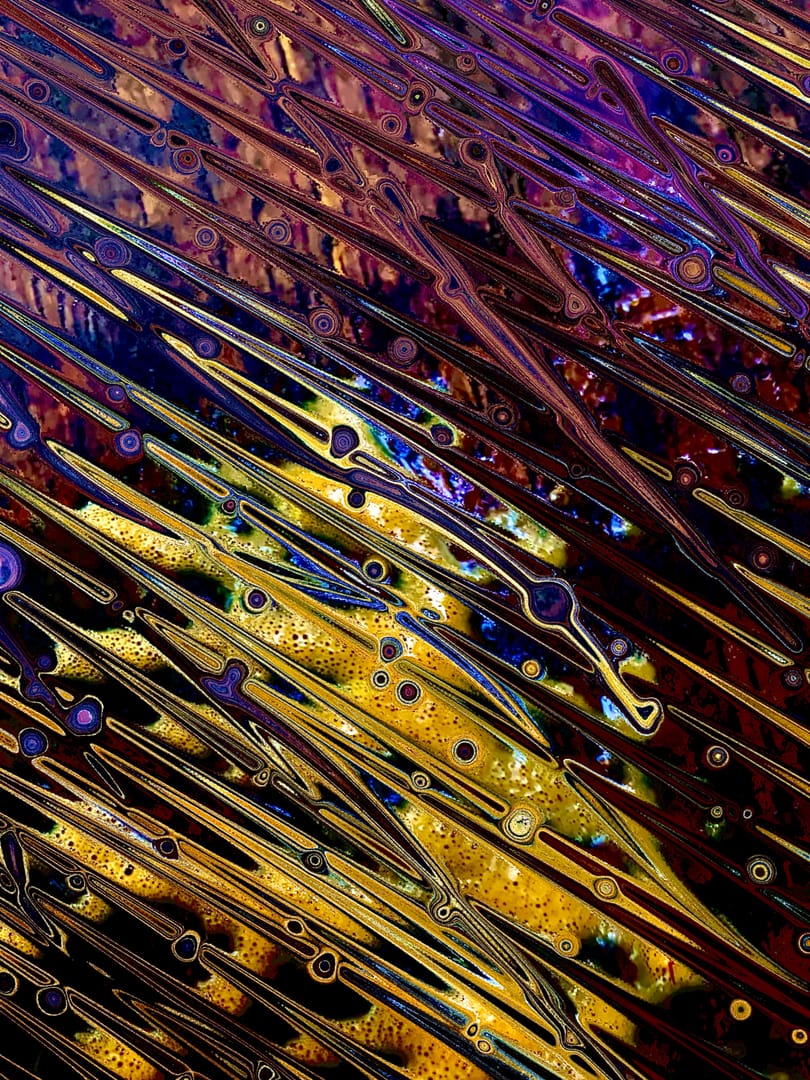
“‘I see colours, yellows and pinks, rising, slanting, little whorls in the gust, shards of white and spikes of black, shimmering. Purples coming and going, polarised reds, so alive.’ We got that from the sound recording, we were filming too but dropped the camera in the water when he lost it.”
“‘It’s so beautiful!’ he said. The last three words he said before tried to scratch out his good eye. It took all four of us to hold him down but the damage was done. He saw the wind but it was the last thing he saw with that new eye. Too many simultaneous inputs, the best we can guess it was like an LSD trip with continuous stimulation.”
Simon now has two basic bionic eyes and neither of them can see the wind. He forgot a simple biological truth. A bird’s brain is not the same as a human brain. It processes inputs differently and much faster.
He saw the wind but no one else ever will. It was beautiful but dangerously overwhelming.
Technique: #digital
Theme:#abstract
Highlight colours: #yellow #purple
Series: #mini-sci-fi
Merchandise: RedBubble
Published in Medium 10 May 2026
